Wednesday, 16 January 2013

Journeys in Beadwork: Culture and Tradition in the Eastern Cape & Dialogues in Contemporary Style (2012)


An international exhibition of beadwork by Mfengu people of the Eastern Cape province of South Africa, presented in partnership with the Nelson Mandela Bay Art Museum, is being displayed at the Shipley Art Gallery. The exhibition will be accompanied by a spectacle of contemporary fashion inspired by traditional beadwork, featuring work from South African Designer Laduma Ngxokolo.
The Shipley Art Gallery, opened in 1917, is recognized as a National Centre for Contemporary Craft and has built up one of the best collections outside of London featuring ceramics, wood, metal, glass, textiles and furniture pieces. It has a permanent collection of over 500 oil paintings and watercolours which make up the ‘Shipley Bequest’. The collection ranges from 16th and 17th century paintings originating from Germany, Italy, Nederland and Belgium to 18th and 19th century British paintings. This venue, on Prince Consort Road, Gateshead, is the setting for the ‘Journeys in Beadwork’ exhibition, on display from the twenty-first of April until the second of September.
The exhibition is in two parts. One part explores the fascinating history of South African beadwork, featuring traditional costumes, clothing and aprons from the Mfengu people and reflects the life of the beaders and their roles and status within their community. For beaders, the work is a reflection of love and self-expression with each colour having a different meaning. In particular, white beads represent spirituality. Items may be given as a gift or during courtship. The more beads an Mfengu person wears, the more loved they are. The display includes items such as aprons, skirts, collars & bags; made by the Mfengu people and worn during rituals; similar to a party outfit, some of which date back to around 1940.

 
 The other section showcases the influence that traditional beadwork has had on contemporary designers such as Laduma Ngxokolo. There is a clear contrast in the two displays. The modern exhibition is much more aesthetically appealing with brighter colours and more flattering fits of clothes. It pushes the boundaries of technological advancements by exploring the idea of combining QR codes with fashion. Thorunn Arnadottir combined modern technology with traditional beadwork to create garments that are scannable by smartphone to unlock information about the wearer. In a time where a person’s most personal information, likes, dislikes, photos and other details are so easily accessible by social networking sites; Thorunn takes the 21st century population closer to controlling how we are perceived when meeting someone in person for the first time.


The Mfengu people originate from South Africa and are closely related to the Zulu. Originally farmers, the Mfengu quickly built themselves schools, created their own newspapers and translated international literature into their own language. They adapted to change easily due to their lack of tribal social-structure. An assortment of over 100 items- collars, anklets, aprons, chest pieces- made by this tribe are on loan to the Shipley from the Nelson Mandela Metropolitan Art Museum and are being shown in the UK for the first time.


Sunday, 13 January 2013

Developing a Textiles brief - C1585

This unit involves making and merchandising a product that will be up for sale at Made in Jesmond. A local shop full of vintage, reloved and handmade products made my local deisgner-makers. My chosen theme for this brief is 'Folkloric'. I chose this theme after seeing a trend report on WGSN. I started my research by looking at artists and designers such as William Morris. I also found influence from designers on the spring/summer 2013 catwalks such as Tadashi Shoji, Temperley London and especially Alice McCall.


Most of my initial research is on my Pinterest in the 'Folk' Board which can be found here > http://pinterest.com/adelleroe/folk/

Alternatively, here is a brief summary of folk related images that I have found most inspiring.

Hungarian folk costume.

FolkLord.

William Morris design.

Tadashi Shoji S/S 13

Matyo embroidery.


Geometrical Print Outcome

The final outcome for the Skills for Making brief was two garment fronts. I abandoned the idea of using screen print as it wasn't working for me much. It was too time consuming for me personally and it was awkward to then construct a pattern from the motifs on the screen as they would all have to be perfectly aligned. My garment fronts ended up being digitally printed to reflect my Photoshop abilities. I then hand embroidered onto one of the designs using a thick yarn. The downfall of digital printing is the cost. Especially since I chose to print on silk.
Here is my first front.

First garment front.
It is styled as a dress with fairly thick straps, a box pleat, a gathered waist and a hand embroidered hem. Although this is styled as a dress I also think it could work as a playsuit.

Hand embroidered running stitch.


My second front is more simple. It is strapless with a gathered waist. I didn't include embroidery in this one because it worked well with out it due to the simple styling.

Second garment front.

Tuesday, 6 November 2012

Geometrical Print Development

After drawing from a selection of research and primary source objects I chose a few things to use as a screen print. Here are some of the negatives from the designs Ive selected.


The first drawing is of the mac keys from my research. I drew it twice in different formats and since I drew it in fine liner it showed through to the next page so I decided to trace it. Which is why some letters are backwards. The second image is a triangular print which fills some of the keys. The designs are done separately so that I can do a two colour way print.


This design was taken from a loose hand drawing of honeycomb. I filled in some of the blocks to add colour to the print rather than just line.


This is a primary source drawing of a keyboard. I drew one of the letters from the keyboard but kept it separate so that I had the choice whether or not to overlay it with the keys. Rather than narrowing down my choices.


Geometry

Choices of themes for the skills for making brief were subterranean, geometrical and folklore. I chose Geometry. To source inspiration for the final print design I looked on websites such as Pinterest (which I love - http://pinterest.com/adelleroe/ ) WGSN and style.com. As well as using periodicals like ShowDetails. These are some of the most inspiring images I found.


Although the final design is for a garment front I also researched other specialisms including ceramics, jewellery, fashion, furniture and illustrations. As a primary source drawing I used an  old typewriter as I thought the repetition of keys were interesting and contrasted to the modern mac keyboard.

Wednesday, 4 July 2012

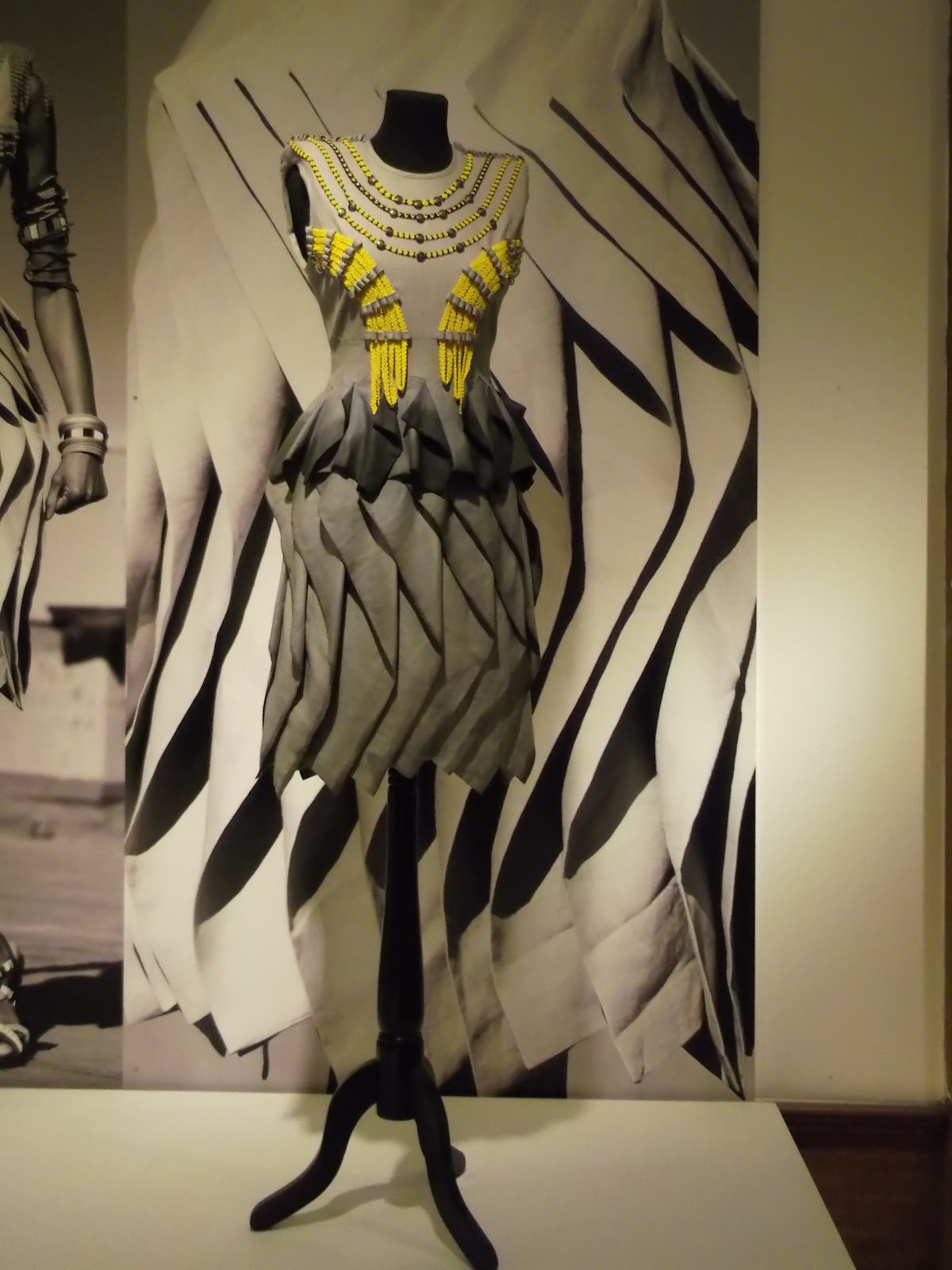
Beadwork @ The Shipley Gallery.

It took two attempts to get here as I couldn't find the gallery the first time. Totally worth it though. Its probably my favourite exhibition this summer. Particularly this dress...


It is appealing to me because of the combination of bead work and the folded fabric manipulation. As well as the colours. I think yellow always compliments grey well.

The Baltic & Lazarides.

I went to see some exhibitions at the Baltic this week. There was an interesting installation by Richard Rigg. It was a mountain hut full of mud, wood and other bits of debris. You could climb in and walk around. I enjoy installations that you can be in amongst. It reminds me of the first exhibition I went to see at the Batlic by Yoshitomo Nara. However, I wasn't allowed to take any photographs!

I still made the most of my new camera and got some pictures of NewcastleGateshead Quayside from the glass balcony. Shame the weather wasn't better.


I was passing the Millennium Bridge as it opened....


I then made my way to Lazarides, The Outsider's Gallery. I love their space. Its so different to other galleries and gives a more relaxed feel.


I was most interested by the work of street artist, OakOak. http://oakoak.canalblog.com/
They use everyday signs and objects in the street and interpret them in a different way. They also made a whole alphabet using photographs of signs and road markings which I thought was very imaginative.
 A wind-up toy mouse out of bike locks.

 A piano out of door steps.


A fish skeleton out of a drain.